
There is no single best fence for a school, and anyone who tells you otherwise is selling you something. What there is, is a right answer for your site: your boundary, your ground, your age group and your budget. Here is how we actually choose, after securing more than 300 schools across Yorkshire.
What a school fence actually has to do
Three jobs, and they pull against each other.
It has to keep people out, which pushes you towards height and anti climb performance. It has to keep pupils in, which is a safeguarding duty and means no footholds, no gaps at the base and no sharp tops. And staff have to be able to see through it, because supervision and CCTV both depend on sightlines.
That last one is why solid fencing rarely suits a school boundary, however private it looks on paper.
The systems we install, and where each one fits
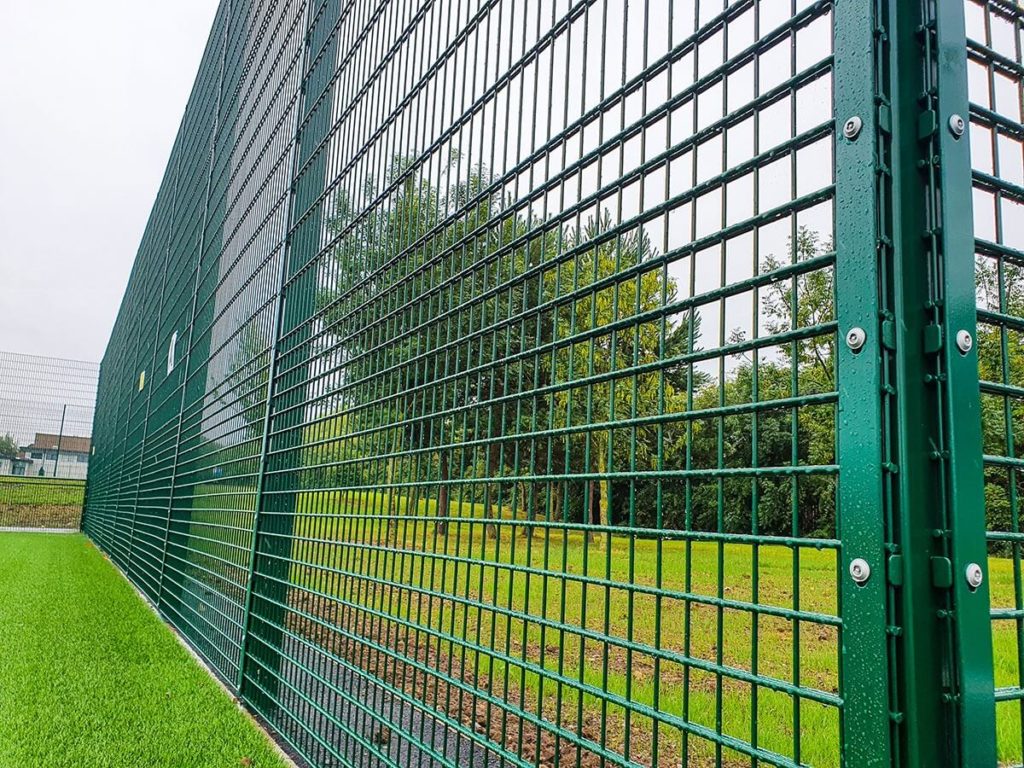
Twin wire 656 mesh
The default for most school perimeters, and what we fit more than anything else. Two horizontal wires either side of each vertical make the panel genuinely rigid, so it resists cutting and does not deform when it gets leant on. Clear visibility, no hiding places along the line, and it still looks straight after fifteen years.
Best for: general school perimeters, primary and secondary.
358 mesh
Sometimes called prison mesh. The 76mm by 12.5mm aperture is too tight for a finger or a foothold and very difficult to cut. It is the strongest option we fit and it costs accordingly.
Best for: boundaries backing onto open ground, alleyways or anywhere with a history of intrusion.
V mesh
Horizontal V profiles pressed into the panel give stiffness without heavy framing. Lighter and cleaner looking than twin wire, and usually a little less money.
Best for: sites where appearance matters and the risk is moderate.
Rolltop and safetop mesh
The top rail is rounded rather than finished with exposed wire ends. That is the whole point of it, and it is why these systems are the standard around MUGAs, ball courts and internal boundaries where children are close to the fence.
Best for: sports areas, playgrounds, internal divisions and safe corridors.
Steel palisade
Very strong, very hard to climb, and very industrial looking. We fit it at schools on service yards, plant compounds and rear boundaries, but we would not normally put triple spiked palisade anywhere pupils gather.
Best for: back of house areas, not playgrounds.
Timber
Attractive, and appropriate on some boundaries where the neighbour relationship matters more than security. It will not stop a determined climber.
Best for: low risk boundaries and screening.
Railings
Bow top and vertical bar railings. Traditional, open, no footholds, and they look right on a front boundary or an entrance courtyard where mesh would feel institutional. We fit fewer of these than we used to, but they still earn their place at the front of a site, usually with matching gates.
Best for: road-facing boundaries and main entrances.
What about chain link?
We get asked about it, and we are straight with schools: we do not install it. It sags, it is easy to climb and cut, and most of the chain link we see on school sites is what we are being asked to take away. If you have inherited it, budget for replacing it rather than patching it.
We would also gently steer you off barbed wire on any school boundary. It creates its own risk and it reads badly to parents and inspectors.
Do not forget the gates
More school fencing projects come unstuck on the gates than on the fence. A pedestrian gate is straightforward. A vehicle gate is a bigger piece of work. And an automated gate is legally classed as machinery, which means it falls under PUWER and has to be maintained, force tested and certificated. More on that on our gate automation page.
How to decide, in practice
Walk your boundary and mark it up. Where is it climbed? Where do pupils congregate? Where can you not see? You will usually find that one stretch needs 358, most of it needs twin wire, and the ball court needs rolltop. Specifying one system for the whole site is the most common and most expensive mistake.
Then get it surveyed before you budget. Ground conditions and access move the price more than the fence type does, and a written specification is what makes a funding case stand up. We have written an honest guide to what school fencing costs and the funding routes schools use.
For the full range of systems, our accreditations and how we programme work around term dates, see our school fencing and gates page, or read more about the mesh systems themselves.