
Schools need a boundary that does two jobs at once: keep the wrong people out, and keep pupils safely in, without the site feeling like a compound. Getting that balance right is most of the job.
We install school fencing and gates for primary and secondary schools, academy trusts and local authorities across Yorkshire. Most of our work happens in the holidays, to programme, so the site is handed back finished before the pupils come back.
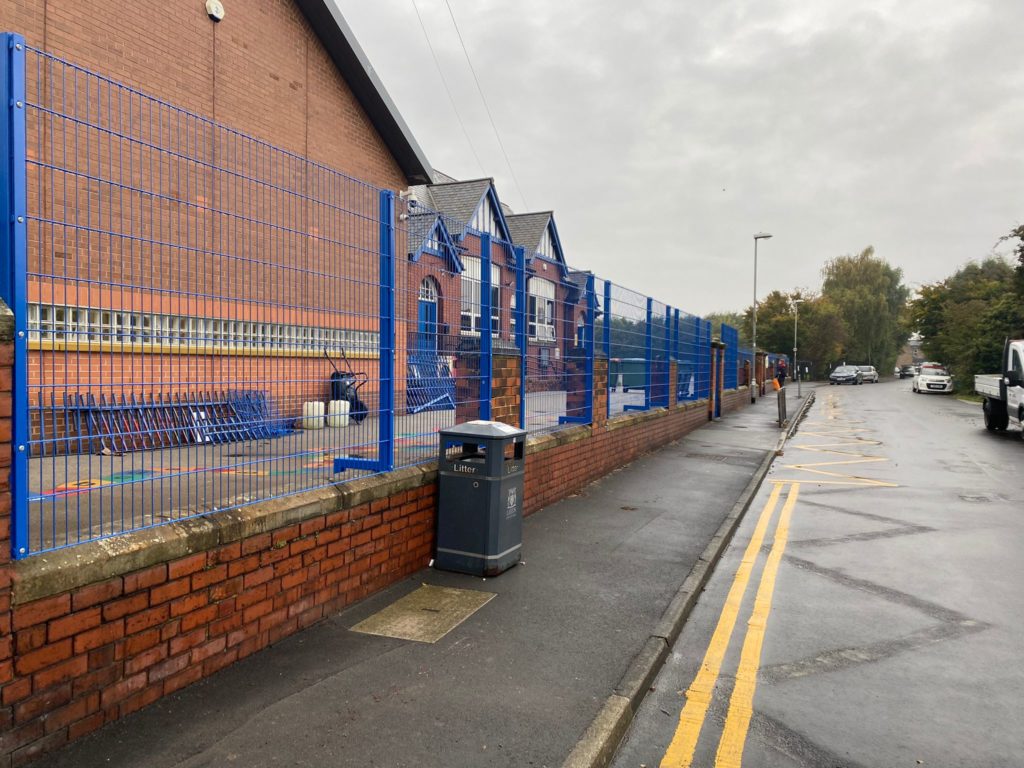
School security fencing that survives a school
A school fence gets treated differently to any other boundary. It gets climbed, leant on, kicked and hit with footballs every day for twenty years, so the specification matters more here than almost anywhere else.
For most school perimeters we fit twin wire 656 mesh, which is rigid, hard to cut and holds its line. Where the risk is higher, on a boundary backing onto open ground for example, 358 mesh is the answer. Around MUGAs and ball courts we use rolltop or safetop, which have a rounded top rail instead of exposed wire ends. Internal boundaries and corridors between buildings usually take a lower rolltop run.
Everything is galvanised and powder coated, normally green RAL 6005. Heights, posts and fixings are modular, so the specification gets matched to each part of the site rather than one system being used everywhere.
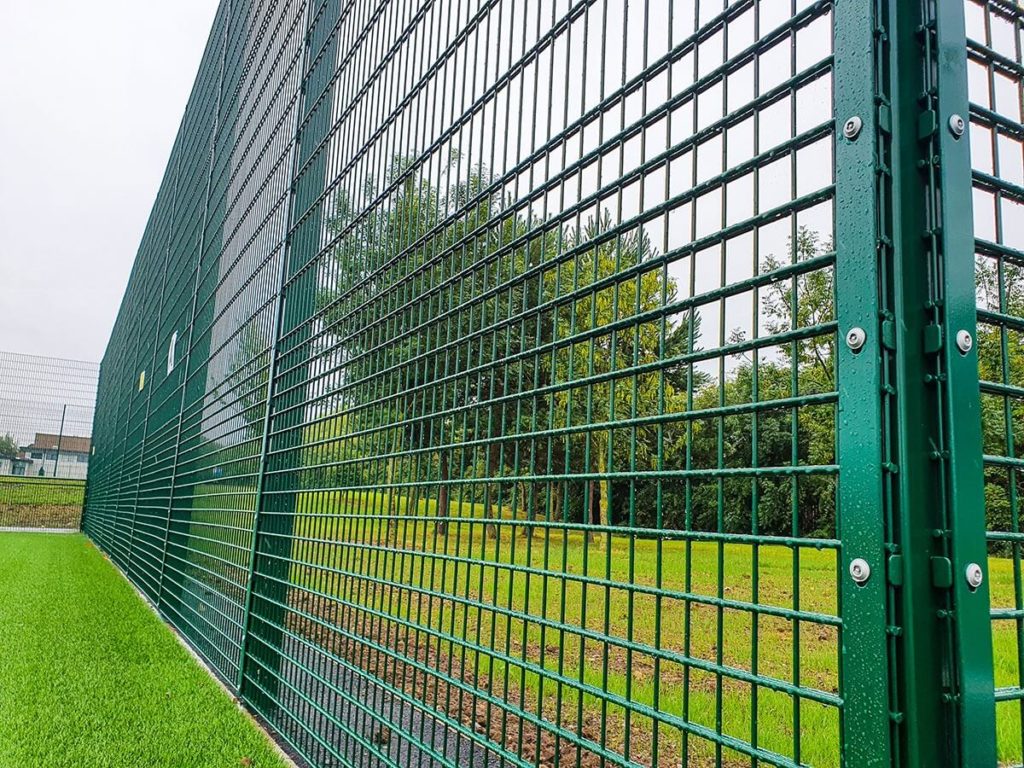
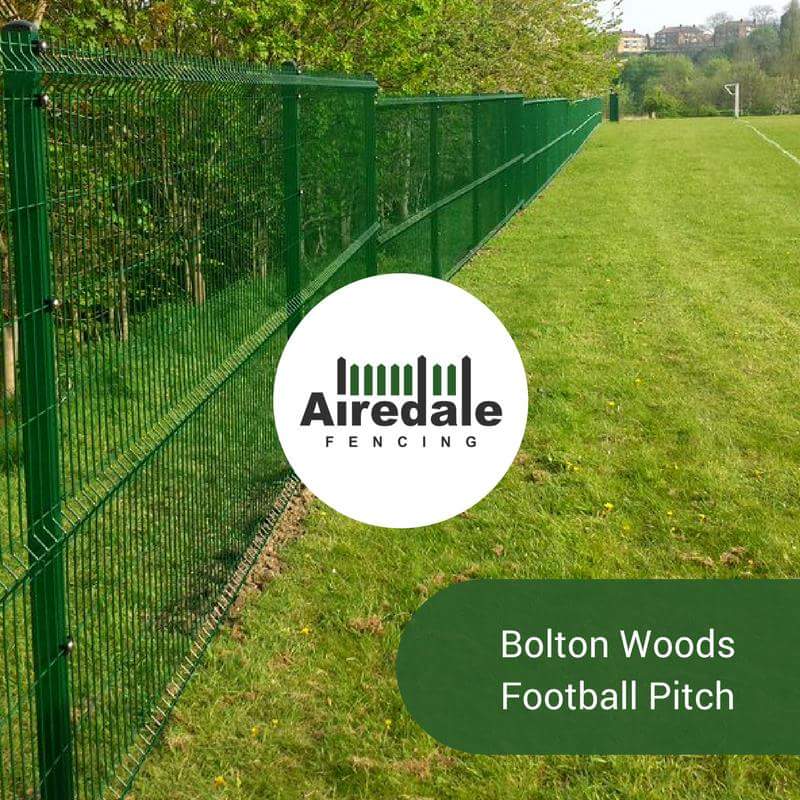
Sturdy and ideal for playgrounds
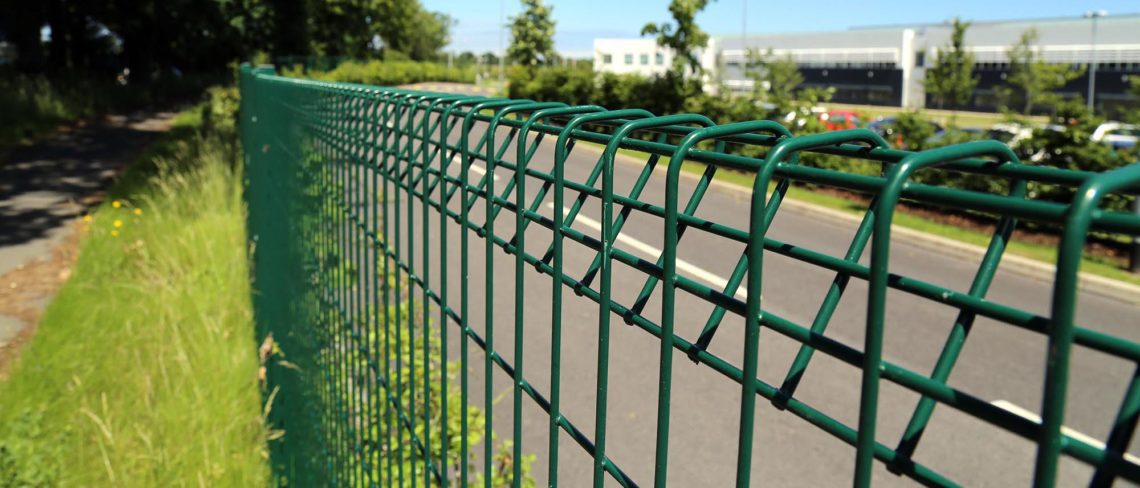
Profiled Wire VMesh
The horizontal Vs in this fencing system give extra sturdiness and resistance without the need for thick and obstructive fence panelling. This means children can look out while being safe within the fence. Profiled wire VMesh fences are also scale- and pierce-proof, as well as vandal-resistant. This fence is ideal for bustling playgrounds and areas where extra sturdiness is needed.
A secure option for schools
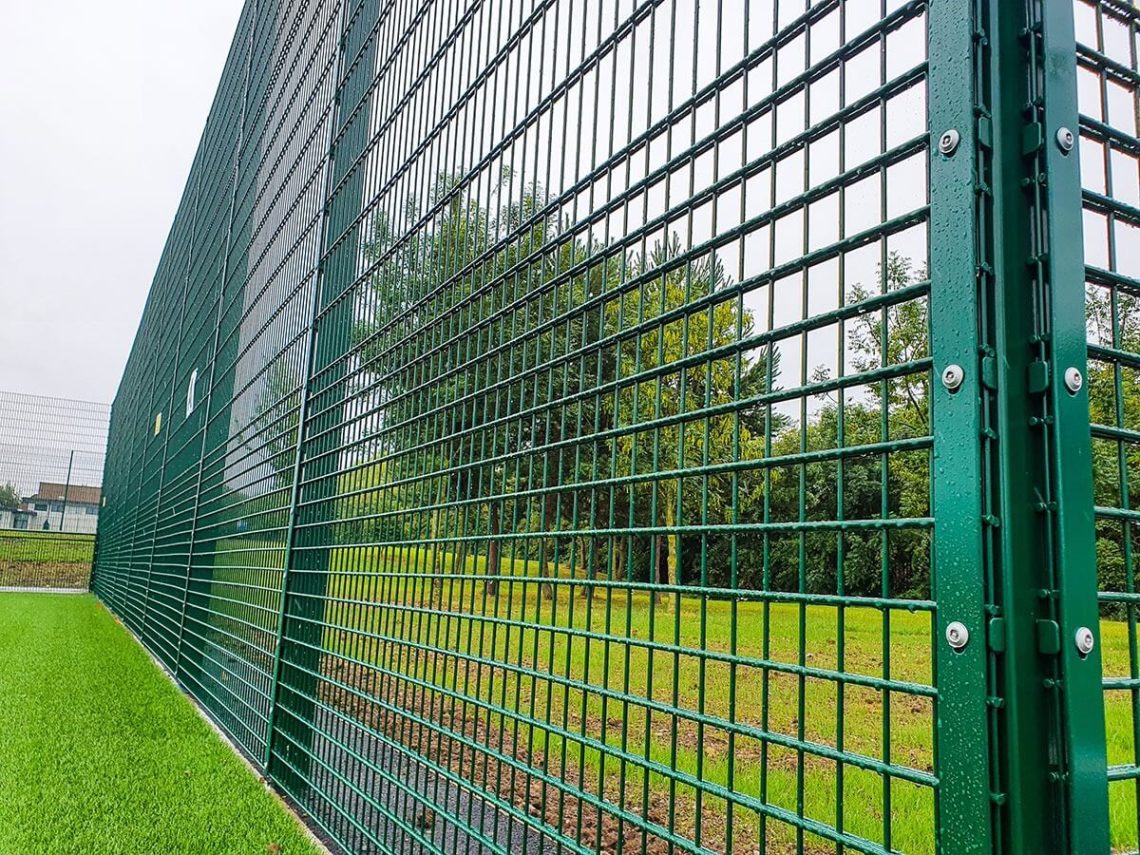
Twin 656 Mesh Panel
This is our most popular design and is great for demarcation, security and sports applications in relatively low impact areas up to a height of 4.0m. The system is attractive and unobtrusive with clear visibility through the panel and no hiding places behind the fence line.
The panels are welded at the intersection points and offer a good resistance to impact damage or vandalism. The top of the fence can be barbed or finished flush depending on safety and security requirements.
Fences can be commissioned from 1.2m in height up to above 4m. Posts are 60 x 60mm square hollow section (SHS) positioned at 2.525m, featuring factory fitted inserts. Panels are attached with robust steel fixing brackets with optional clamping strips for greater security, and tamper-proof bolts.
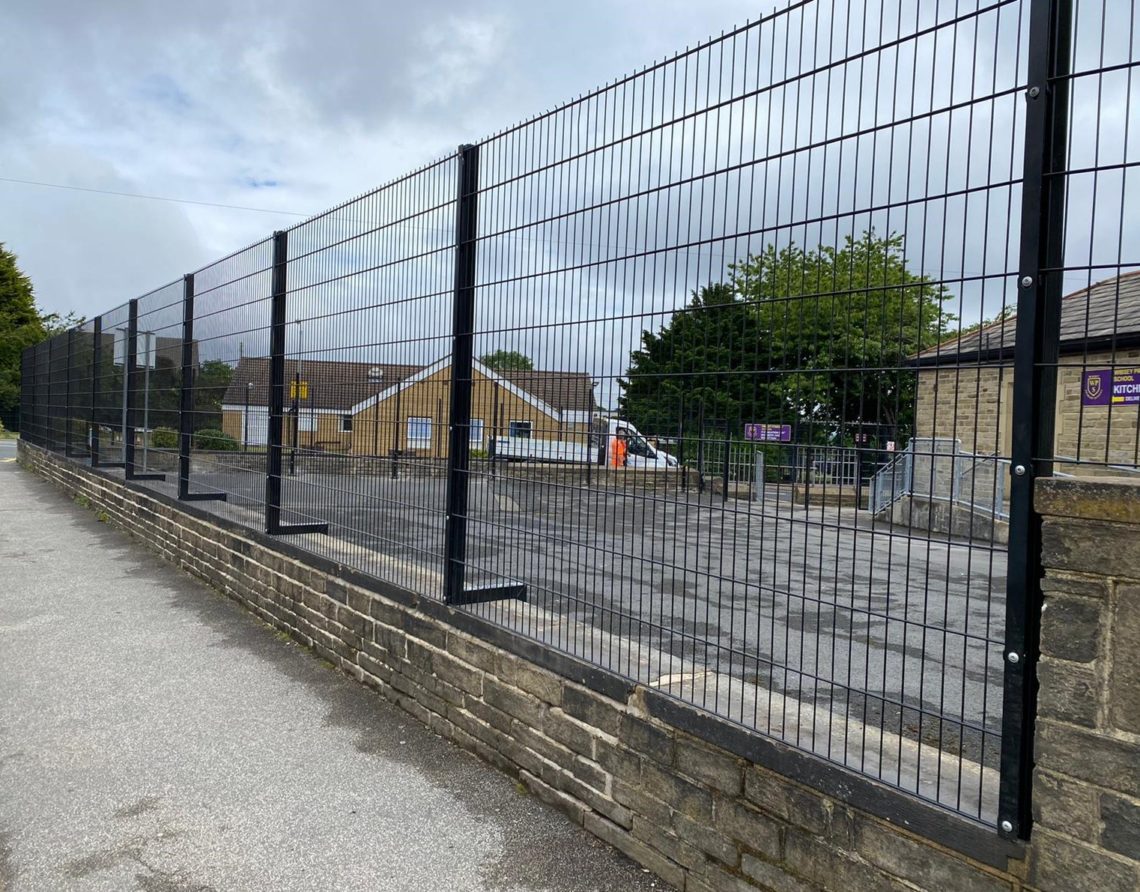
Super sturdy. Great for sports applications
Roll Safetop Mesh
This fencing system has unique and user friendly features. Roll top safe mesh systems are suitable where safety is a consideration and is the ideal choice for schools on internal boundaries. Usually installed at a height of 1.2m high to provide a safe corridor or separation for children in schools. The benefits of this type are excellent through vision, high rigidity, and aesthetic appearance.
A secure option for schools
Sports & Multi-Use Games Areas
A MUGA fence takes punishment that a perimeter fence never sees. Balls hit it hard, hundreds of times a day, and pupils will climb it if it gives them anywhere to get a foot.
So we build them differently. Rebound panels are heavier gauge, fixed to take repeated impact without deforming, and set out so there is no gap at the base for a ball to squeeze under and no horizontal rail partway up to use as a step. Heights are usually 2.4m to 4.0m depending on the sport, and we will tell you honestly if a lower fence will just mean somebody fetching balls off the road all term.
Corners are where MUGA fences fail first, so we fit purpose made rebound corner sections rather than butting two panels together. Galvanised and powder coated in any RAL colour, green RAL 6005 and black being the usual choices for playing fields.
Why schools trust Airedale Fencing
Choosing a fencing contractor for a school is not like any other job. Here is what you get with us as standard:
- Accredited: CHAS certified (CHAS-0024323) and SSIP assessed through PQS, Gate Safe accredited, and a member of the Automatic Door Installation Association. Marc holds the ADIA Authorised Automatic Gate and Barrier Technician accreditation awarded through City and Guilds, which is QR verifiable.
- Safeguarding first: Enhanced DBS checked installation teams, used to working on live school sites during term time.
- Recognised site cards (CSCS, ADIA, ECS or GateSafe) on every installer.
- Fully in-house installation team, no subcontractors, so you always know who is on your site.
- 12-month workmanship warranty on all installation work.
- 300+ schools secured, backed by 35+ years’ experience across Leeds, Bradford and wider Yorkshire.
See how a real school fencing job runs at Denholme Primary, and get in touch for a no-obligation survey.
We have gates to complement each fencing range
From manual, automated and robust access control solutions, we’ve got you covered!
Gates, and the bit that gets overlooked
An automated gate is legally classed as machinery, which puts it under the Provision and Use of Work Equipment Regulations 1998, better known as PUWER. It has to be maintained, inspected and safe in use, and the duty sits with the school or trust as the responsible body.
The catch is that what keeps an automated gate safe is mostly invisible. Photocells, safety edges, and the force the gate applies when it meets an obstruction. A gate can drift out of compliance quietly over a few years and keep opening and closing the whole time it does.
So every gate we install or service gets its force readings measured against BS EN 12453 and BS EN 12445, recorded, and issued to you as a certificate. Not a tick and a signature. Actual figures, on paper, that you can put in front of an inspector.
We service every six months rather than annually, which matches the minimum Gate Safe recommend and Jacksons Fencing publish, and reflects the fact that a school gate cycles dozens of times a day in term time. More on our gate automation page.
What about cost, and is there any funding?
A fair question, and a frustratingly hard one to answer online, because the honest answer is that it depends on the specification, the ground, the access and the gates. We have written a straight guide to what drives the cost of school fencing and the funding routes schools typically use, with no sales pitch in it.
If you look after several sites, our multi academy trusts page explains how we handle whole estates.
School railings
We still install railings at schools, usually bow top or vertical bar, and usually where a boundary faces a road or a main entrance and has to look right as well as work. Railings give you a traditional, open look with no footholds, and they suit front boundaries, entrance courtyards and areas where a mesh fence would feel institutional.
For most of a school perimeter we would still specify mesh, because it costs less and performs better against climbing. Railings earn their place at the front of the site. We fabricate and fit them alongside matching gates, so the entrance reads as one thing rather than three.
Where we work
We are based in Bradford and cover roughly an hour from BD10. That takes in Leeds, Bradford, Wakefield, Huddersfield, Halifax, Harrogate and York, and reaches into South Yorkshire for Sheffield, Rotherham, Barnsley and Doncaster.
If you run more than one site, our multi academy trust page sets out how we handle trust wide programmes. For the fencing systems themselves see mesh fencing and perimeter fencing. Gates, from a simple pedestrian gate to a fully automated vehicle entrance with intercom and fobs, are covered under gate automation and access control.